The True Cost of “Cheap”: Why Small Businesses Should Skip Content Mills and AI in Their Marketing (And What To Do Instead)
What if you could populate your website and blog with a tonne of content, start ranking on Google, and start getting customers and clients almost immediately, with minimal effort and at little or no cost?
If this sounds too good to be true, it’s because it is.
Unfortunately, I see this false promise all the time. I’ve been hired by more than one business owner who was taken in by it and turned to a content mill (as defined below) or generative AI tool for their written content.
In the vast majority of cases, the results are the same. And that’s because there is one glaring problem with ultra-fast, ultra-cheap content: it doesn’t work.
Starting, running, and marketing a small business is both expensive and time-consuming. I completely understand the desire to get something off your plate as quickly and cheaply as possible.
But at best, turning to AI or a content mill is a false economy. At worst, it’s actively destructive.
How do I know this? Because, when business owners have tried to entrust their precious vision to a content mill or AI tool, I’m often the one ultimately hired to fix it.
My goal for this post is to stop you falling into this trap and being seduced by the lie that AI or content mills are a suitable replacement for professionally-written content.
And, of course, I’ll show you what you can do instead to actually get the results you deserve and start converting customers with your content.
What is a Content Mill and Why Is Using One a Mistake?
A content mill or content farm acts as a middleman or broker, offering clients a large volume of content at a very low cost and then subcontracting writers to produce it. The content mill business model is very much based on volume, speed, and low prices, often with little or no quality control.
NUANCE: For the purposes of this post, I’m including platforms like Fiverr and Freelancer.com under the banner of “content mills.” Though they work slightly differently, in that the “middleman” is the platform and prospective clients are able to contact freelancers directly, the race-to-the-bottom pricing model and poor quality of resulting work are often the same.
Now that you understand what a content mill is, let’s look at some of the reasons I advise against them.
Content Mill Output is Weak and Generic
You may have heard of the “triple constraint,” also known as “fast, cheap, good.” The simple version is that you can have any two of those three characteristics in a piece of work, but never all of them together.
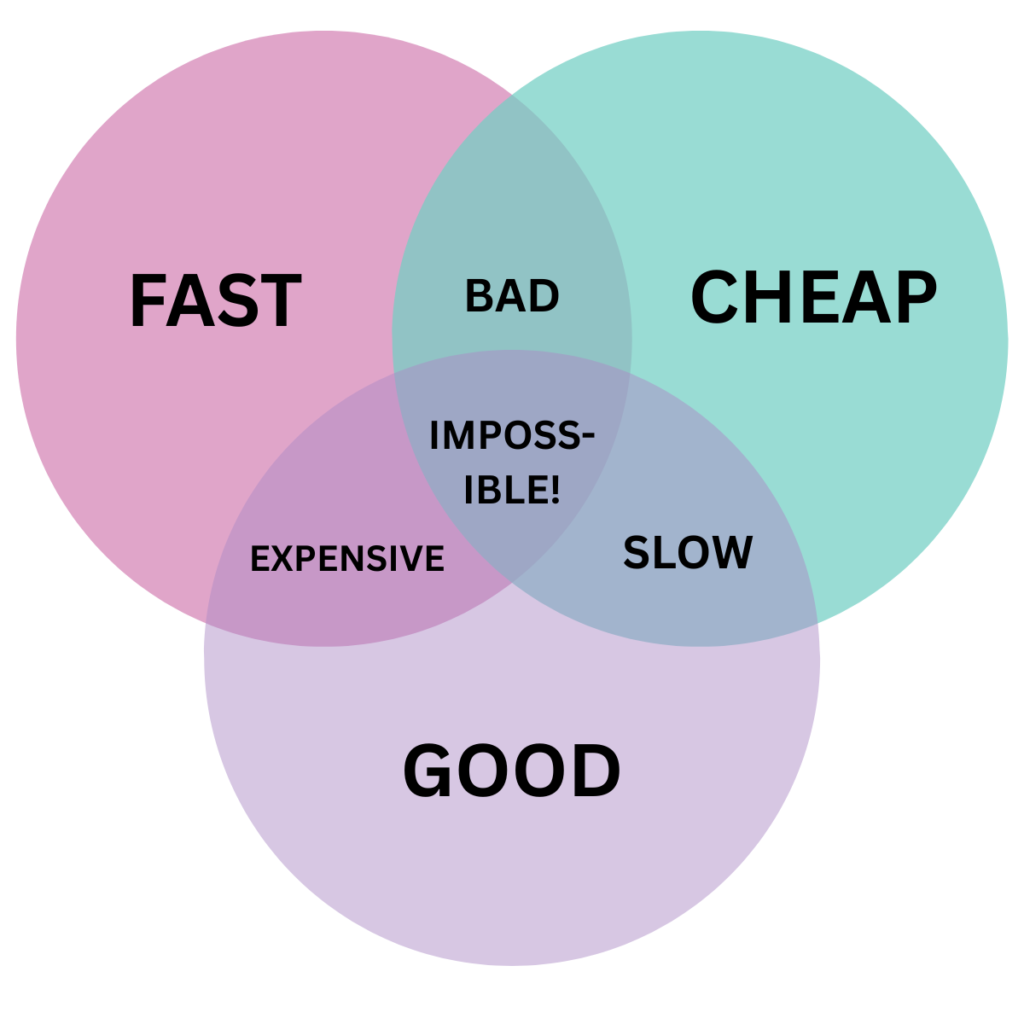
Content mill output is fast and cheap. It is not good.
Since writers are given so little time to properly research and understand topics, and may never even speak directly to clients at all, the resulting content is thin and generic. And, because many content mills pay by the word or set minimum word counts for articles, content tends to be padded with filler and “fluff” that offers no actual value.
With little oversight and quality control, content mill output is often minimally edited or not edited at all. This means it’s likely to be riddled with spelling and grammatical errors, weak syntax, and structural problems. And, though many content mills claim to be all about SEO, few offer anything more sophisticated than heavy-handed keyword stuffing.
Content Mill Output Won’t Convert
If you’re a business owner or service provider investing in content, it’s probably because you want that content to achieve something for you. Most likely, your goal is to attract clients, build relationships with prospects, drive sales, or some combination of the above.
Aside from the overall low quality we discussed above, content mill material is unlikely to convert because:
- It is not aligned with your ideal customer profile and does not speak to actual needs, desires, or problems (since the writer has little or no time to get to know you, your business, and your audience)
- The calls to action, if any, will be low-quality and generic rather than specific, targeted, and conversion-oriented
- It actively harms customer trust and undermines your reputation as a trustworthy authority in your space
Your Voice Gets Lost
Because content mill writers have such limited time to work on your content, and may never even speak to you directly, it is impossible for them to build any real knowledge of your brand, your people, or your values.
This means that your voice gets lost. And without an authentic brand voice or appropriate positioning, your content will be boring and forgettable, ultimately disappearing amidst all the other internet noise.
Content Mills Exploit Writers
Content mills pay extremely low rates, meaning that writers must create a massive volume of work to earn anything close to a living wage (and even then, many don’t.)
Paying £10 for an 800 word article is not normal. Paying £0.02 per word is not normal.
Sometimes, work will be rejected for arbitrary reasons or clients will simply vanish, leaving writers with nothing to show for many hours of work.
I hope I don’t have to spell out why none of this is okay.
These companies frequently target newer writers and those in lower cost-of-living areas. But we should not be accepting exploitation because someone lacks experience or because of where they happen to live.
This practice not only harms the writers the content mills hire, but also harms all of us by driving industry rates down and creating race-to-the-bottom pricing models I discussed above.
It’s Probably AI-Generated Anyway
Because writers are under so much pressure to churn out material at absurd volumes, and because there is little or no quality control under the content mill model, many “writers” in this industry are now simply generating all their content with AI.
Some content mills are even bypassing writers altogether, instead simply passing off AI-generated content to clients under a made up writer name.
Why Shouldn’t You Use Generative AI to Create Your Content?
NB: “generative AI” specifically refers to platforms like ChatGPT, Claude, and Gemini, which synthesise huge amounts of training data and use it to generate text, images, video, or other outputs.
Generative AI is being pushed incredibly hard by some of the world’s most powerful companies. They have almost unlimited marketing budgets propaganda machines at their disposal.
It’s no wonder people are falling for it.
So let’s talk about why I don’t recommend using generative AI to create your content and why it almost certainly won’t get you results.
AI-Generated Content is Bad, Boring, and Soulless
You’ll find a lot of information out there about the “surefire tells” that content was written by AI. Large language models famously love em dashes, groups of three, and the Oxford comma (see what I did there?)
They also love certain words and phrases. “And honestly?” “It’s not X, it’s Y.” Clarity, synergy, leverage… it goes on.
I think these so-called “tells” are reductive and often inaccurate. The reason LLMs like those phrases and punctuation quirks is because human writers use them (and all generative AI does is regurgitate versions of whatever it’s been fed.
The real AI tell is more nebulous but, once you become attuned to it, you start to see it everywhere.
The tell is that it’s soulless.
There’s no rhythm, no musicality, no rise and fall of emotion. The message may appear deep and profound at first glance, but when you scratch the surface it’s meaningless. The spelling and grammar are likely perfect, but the work makes you feel absolutely nothing.
AI Content Damages Trust and Engagement
Would you want to speak to a robot? Your clients don’t, either.
There is a significant trust gap in the world of AI.
Many businesses and marketers have adopted it rapidly, but overall consumer trust is much lower. According to one study, 48% of participants said they trusted content less if they even suspected it was AI generated.
And yes, despite what tech firms will tell you, many people absolutely can tell.
For small businesses, ethical brands, service providers, and solo entrepreneurs, this impact is likely to be even more pronounced. Your customers care about your values, your mission, and what you stand for. In other words, they care about you.
This means that posting AI-generated content is likely to actively harm customer trust in your brand and lower your audience’s levels of engagement with you.
Generative AI is a Massive Ethical Issue
The unchecked rise of generative AI has huge implications for the environment, human rights, human intelligence, and the creative industries. While I know not everyone shares my total-boycott stance on these technologies, I hope more people will at least pause and think before using them.
An important caveat: if you weren’t aware of these issues, please don’t feel ashamed. There are people with near-limitless money and power who have a vested interest in keeping us uninformed. Even many of us in the anti-AI movement played around with ChatGPT in the early days, before we learned all this.
Poor Quality Content is Content You’ll Pay For Twice
I’m passionate about sustainability and, wherever possible, I try to live by the “buy once, buy well” philosophy. This principle means investing in quality, durable products that will stand the test of time, rather than cheap, throwaway versions that will end up in landfill in a couple of years.
What does this have to do with copywriting? Well, I think “buy once, buy well” can also apply to your website and marketing content.
As my fellow writers and I have seen again and again, when you choose cheap content you’ll end up spending more in the long run to fix it.
This could mean spending more money, by hiring someone like me to turn slop into sparkle, or it could mean spending a huge amount of time fixing it yourself (which, presumably, negates the entire point of outsourcing the writing to begin with.)
But whether you’re paying in time or money, low quality content is content you’ll ultimately pay for twice.
Why not buy once and well instead? I designed my cornerstone content packages around the philosophy of “invest once, benefit for years.”
So What Can You Do Instead?
So far, I’ve told you what I think you shouldn’t do, and I’ve explained why.
If you’re still with me, you’re probably wondering what I would like you to do instead. As I see it, there are two great options available to you. Let’s look at them and consider the pros and cons of each!
Option 1: DIY It
“Do it yourself” isn’t just for, well, DIY. If you like, you can also choose to take ownership of your business content by writing it yourself (or asking someone in your team to do so.)
Pros of DIY Content
This is by far the cheapest way to create your content, if you have the time to invest in it and the skills to do so.
Creating your own content allows you to get your authentic voice out there and show your audience who you really are with no filter. You retain total creative control, and you can adapt and respond rapidly to changes or industry news, if necessary.
DIY-ing your content can also offer you opportunities to develop your skills or learn new ones. You’ll practice writing, of course, but you might also learn about things like digital marketing, SEO, and working with content management systems.
Cons of DIY Content
Creating good content takes a lot of time. This means you’ll be investing many hours that could be spent elsewhere–serving your clients, refining your product or service, or even spending time with your family.
If you sacrifice client work to create content, you might see a dip in revenue. If you try to add it in on top of your existing workload, you’re at risk for exhaustion and burnout.
While anyone can learn to write good content with enough time and practice, it is a steep learning curve and not something that can be developed overnight. Business copywriting and content writing is far more than just good spelling and grammar. It requires an in-depth understanding of craft, syntax, positioning, voice, buyer behaviour, and more.
For this reason, I wouldn’t recommend DIY content creation to anyone who isn’t already a strong writer with at least some knowledge of best marketing practices.
Option 2: Hire an Expert
Your second option for content creation that gets results and makes you money is to hire an expert.
Pros of Hiring an Expert Content Writer
When you hire a professional copywriter or content writer, you’re bringing in years of expertise in not just how to write, but how to adapt messaging for a specific audience and drive the reader to take action.
An external expert can also offer a fresh perspective. As a business owner, you’re understandably closer to your product or offer than anyone else. But this can result in “missing the wood for the trees.”
Your expertise is your biggest asset, but it can also hinder clear communication with your audience—that’s why one of the first things I do, when I’m looking at a client’s existing content, is strip out all the industry jargon and put it into plain, accessible language.
A good writer knows how to ask the right questions, giving you clarity and helping you to position your offer in the most effective way.
Skilled writers can adapt to your brand voice and personality, producing content that sounds like you and has a consistent tone across platforms and channels.
And, of course, you’ll save time! Handing off responsibility for your written content keeps you (and your team, if you have one) free to keep doing the things you do best.
Cons of Hiring an Expert Content Writer
The biggest downside of bringing in an expert writer, of course, is the cost. As we’ve established, bottom-of-the-barrel rates likely mean poor quality work, and a skilled copywriter doesn’t come cheap.
(My day rates start at £350, individual articles or pages start at £299, and my cornerstone content packages start at £4999. This is fairly typical for this type of work from a writer of my calibre.)
Working with a writer also requires some time input on your side.
I’m pretty amazing at what I do, but I haven’t cracked mind-reading (yet 😉). You’ll need to be ready to talk about your vision, your values, your products or services, and your goals for your content if you want the best results.
“Isn’t Some Content Better Than No Content, Even If It’s Not Ideal?”
This is a common misconception, but the answer is… not really.
Yes, you need content to get a business website off the ground and to start promoting your products or services. And your content does not need to be perfect to start getting you results.
But poor quality content, of the kind that typically comes out of content mills and generative AI tools, will probably do more harm than good.
As we’ve established, low quality content can harm customer trust and do lasting damage to your brand reputation. It can also damage your search performance, making it harder for people to find you.
Faster is not always better, and something isn’t always better than nothing.
Either taking the time to write great content yourself, or investing in a skilled writer to do it for you, are far better options than rushing your website or blog out with sub-par writing or AI slop.
Let Me Build You a Package of Content That Converts
Whether you’ve already tried a content mill or AI and found the results disappointing, or you’re just starting out and want to avoid making this common mistake, I’d love to help!
When you work with me on a cornerstone content package, you’ll get:
✔️ 10-20 pieces of bespoke, professionally-written, longform blog content designed to demonstrate your expertise and ultimately make you money (plus ideas for how to use them in all your future marketing!)
✔️A consistent voice that sounds like you and shows your ideal clients exactly how amazing you are
✔️ Your time back to focus on building your business, serving your clients, and living your life while I focus on writing words that sell
Instead of wasting your time and money on content that’s never going to get the job done, I’ll deliver the messaging and positioning your brilliance deserves.
→ Curious? Ready? Book a free discovery call and talk to me today!